Have you thought about using your Motability Scheme car to explore a new place, or visit an old favourite? If you’re planning to drive on country roads, check out these useful driving tips from Scheme customer Helen Dolphin.
Whether you’re visiting a lovely coastal town in Cornwall, enjoying boating on the broads in Norfolk or heading off to Wales for some fresh mountain air, you’re likely to need to negotiate country roads to get there.
Country roads make up over half of the UK’s road network. Covering almost 200,000 miles, these minor roads are very common, in contrast to motorways that account for only 2,300 miles of the road network.
Although many people think motorways are the most challenging roads to drive on, country roads can need a bit more care. They make up over half of the UK’s road network, so chances are you’ll use them at some point on your journey.
For those of us who drive on rural roads regularly, they soon feel familiar. But if you do not often drive outside towns or cities, they can feel different at first. That is nothing to worry about. A little awareness and a few simple adjustments can help you feel confident and stay safe.
That is why it helps to know what to look out for before you set off.
Tractors and farm vehicles
It’s easy to forget just how much farm traffic you encounter on a single trip. On one short stretch of road on a journey from Norfolk to Staffordshire, I came across four tractors and two combine harvesters.
It’s possible to overtake where the road is clear ahead, but in the past I’ve seen people overtaking on bends, or where there was no clear view. Although there are lots of lovely hedgerows bordering the road, you really do not want to end up buried in one of them! In most cases, this farm traffic turns off very soon so you’re rarely held up for long.
Top tip: Build extra time into rural journeys. When you are not in a rush, slower-moving traffic feels less frustrating and you are more likely to make safer decisions. Stay patient and wait for a clear, straight stretch of road before overtaking.
Your package on the Scheme
If something happens to you while you’re driving on a country road, your Motability Scheme all-inclusive package can help.
The Scheme offers RAC breakdown cover for any journey in the UK. Report your incident via the app or call the RAC on 0800 73 111 73 and they’ll try to get someone out to you as soon as possible.
If you’ve had an accident, register a claim with Direct Line Motability (DLM). Call DLM directly on 0300 037 3737 to register a claim, or make one in your Motability Scheme online account.
Animals
It is not that common in agricultural Norfolk to meet farm animals on the road, but if you’re off to Wales do be prepared to meet a flock of sheep being moved (or just a few odd ones who have escaped and are taking themselves for a walk). They obviously have no idea of the rules of the road and will just take their own time to wander back onto the verge. When I was driving in Scotland I came across a Highland cow in the middle of the road, which was quite a shock as it is a considerable size and has very big horns.
However, it’s not just farm animals that you’ll encounter on country roads. I think one of my worst experiences of an animal on the road was when I was driving in Norfolk at dusk when a deer ran in front of my car. I was lucky to be able to brake and miss it as they can cause considerable damage to you and your vehicle. Some areas in the UK are worse than others, and some hotspots include: the A134 in Thetford Forest, A22 in Ashdown Forest, B4506 in Ashridge Forest, A4136 in the Forest of Dean, and M27 between Southampton and Portsmouth. So if you’re going through these areas, make sure to take extra care, especially at dawn or dusk. If you do hit a deer, you should make sure you and any passengers are safe, before then reporting the accident to the police. The police can also contact specialists to look after injured deer.
And if you’re travelling with a canine companion, make sure to read our guide on travelling with a dog in the car.
Top tip: Scan the verges as well as the road ahead. Movement at the side of the road is often the first sign that an animal might cross.
Horses
Horse riding is popular in many areas and it’s not uncommon to come across one or more horses being ridden on the road. However, because of a large number of accidents involving horses the British Horse Society (BHS), the UK’s largest equestrian charity, launched a campaign called “Dead Slow”, which aims to educate drivers on how to safely pass a horse on the road.
Their advice to drivers is to slow down to a maximum of 15mph when you meet a horse and rider on the road, and to leave at least a car width between your vehicle and the horse, passing wide and slow, without revving your engine or sounding your horn. It seems surprising that people don’t already know this, but there are clearly lots of people who don’t as there were over 3,000 incidents involving horses on UK roads in 2024, according to BHS.
Top tip: Think of your car as unpredictable from a horse’s point of view. A gentle approach helps avoid sudden reactions that neither you nor the rider can control.
Cyclists
My husband is an avid cyclist and every weekend goes out with his cycling club on the roads around Norfolk. He often has a story or two about a bad driver they encountered on the way, who was not aware of how to treat cyclists on the road.
It is worth remembering that the Highway Code requires vehicles to give cyclists at least as much space as they would give when overtaking a car. The code also encourages cyclists to ride in the middle of the road where there is not enough room for a car to overtake safely. My husband reports that a lot of motorists think they are doing this deliberately to hold up the traffic, but it is just for their own safety.
Top tip: Hold back early rather than edging closer. Leaving space from the start reduces pressure on both you and the cyclist.

Road surface
With farm vehicles using the country roads, it’s not uncommon to find a large trail of mud. This is usually fine when it’s dry, but when it rains the mud can make the road surface really slippery. If this is the case, be sure to drive with extra care.
As well as mud you may come across patches of standing water where it just hasn’t drained away. The last thing you want to do is aquaplane into a ditch. The best advice from the RAC to avoid aquaplaning is to hold the steering wheel straight and gradually ease your foot off the accelerator. The last thing you should do is hit your brakes hard. To prevent aquaplaning, the RAC advise that you should make sure your tyres are in good condition and don’t drive too fast.
Top tip: Let the road set the pace. If the surface looks poor, adjust your speed before you reach it, not while you are already on it.
Potholes
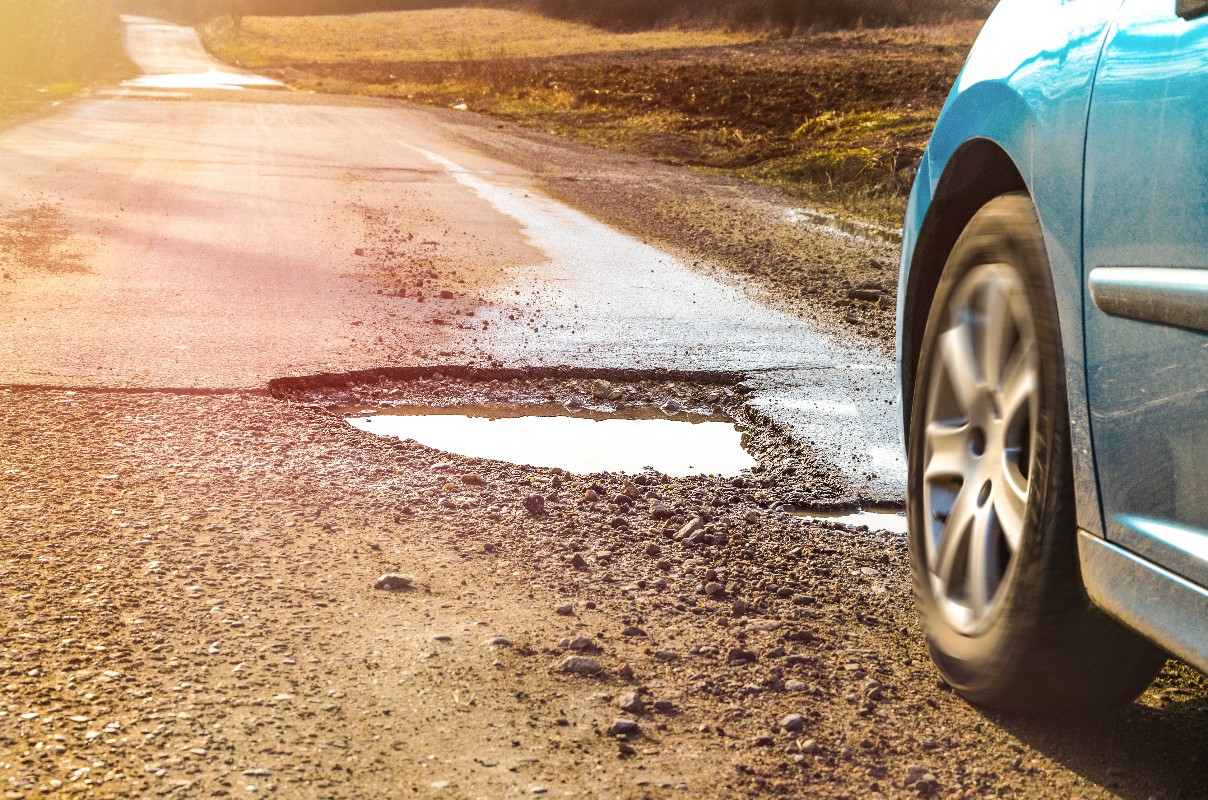
Country roads often hide potholes, especially after heavy rain or cold weather. They can be hard to spot and can cause damage if you hit them at speed. Estimates from the RAC show there are six potholes for every mile of council-controlled roads in England and Wales, so it is certainly something to be aware of. Slowing down on unfamiliar roads and keeping a safe distance from the vehicle in front can help you spot problems earlier.
It is also worth thinking about fair usage. Your Motability Scheme car is designed for everyday driving, but repeated damage from poor road conditions can add up over time. Fair usage means taking reasonable care of the car, just as you would if you owned it yourself. That includes avoiding obvious hazards where you can, driving at sensible speeds and reporting issues early if something does not feel right.
Some wear and tear is expected, especially on rural roads. But avoidable damage, like regularly hitting potholes at speed, can lead to repairs that could have been prevented. Looking after your car helps keep it safe, reliable and ready for the journeys that matter most.
Top tip: If you cannot avoid a pothole, slow down safely and try to drive straight over it. Avoid sharp braking or swerving, which can increase the risk of losing control.
Want to learn more about potholes? Check out our guide for driving safely on potholed roads.
Driving on country roads can be enjoyable, but it comes with different challenges. A little extra awareness goes a long way.
Key things to remember:
-
Expect the unexpected, especially around bends and on narrow roads
-
Slow down for animals, horses, cyclists and poor road surfaces
-
Take care of your car by driving considerately and avoiding avoidable damage
-
Staying calm and patient helps keep you, your passengers and others safe
With the right mindset and a steady approach, country roads can be just as safe as they are scenic. And if you’ve recently made the switch to electric, check out our tips for planning a long trip with an electric vehicle (EV).
Get more safe driving tips in your inbox
Once a month, we’ll send you a handful of stories we think you’ll like.
Stay up to date with tips, Scheme news and inspiration.
Related articles
How to get the most from your car’s infotainment system